


Animal Drugs for New World Screwworm
As of September 3, 2026, the FDA has issued 15 Emergency Use Authorizations (EUAs) and three conditional approvals for animal drugs against New World screwworm.
New World screwworm (NWS), Cochliomyia hominivorax, is a parasitic fly that lays eggs in and on open wounds and mucous membranes of warm-blooded animals. NWS larvae (maggots) burrow into the flesh of these animals and eat healthy living tissue. This infestation with larvae is called myiasis. NWS can infest livestock, pets, wildlife, occasionally birds, and in rare cases, people. The damage caused by NWS in animals can be serious and is often deadly to the animal.
FDA-Conditionally Approved and Authorized Animal Drug Options for New World Screwworm (Infographic)
The FDA has expanded access to medications to prevent and treat NWS in animals.
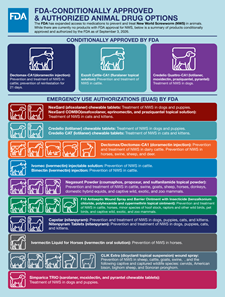
The FDA’s Center for Veterinary Medicine (CVM) is working closely with the U.S. Department of Agriculture (USDA), the Environmental Protection Agency (EPA), other U.S. government departments and agencies, and state animal health officials to address the threat of NWS. For updates from U.S. governmental partners on NWS, visit: Screwworm.gov.
CVM is working with drug sponsors, federal and state partners, and international regulators to understand options for U.S. veterinarians to treat NWS effectively and safely.
On New World Screwworm: Information for Veterinarians, CVM provides information to support veterinarians with the identification of FDA regulated products to prevent and treat NWS myiasis.
Animal drug sponsors interested in pursuing an approval or authorization for the use of an animal drug for NWS should email AnimalDrugNWS@fda.hhs.gov.
NWS News from FDA
September 3, 2026: FDA Issues Emergency Use Authorization for Drugs to Prevent and Treat New World Screwworm in Dogs and Cats (Capstar, revision of generic Nitenpyram Tablets)
August 27, 2026: FDA Issues Emergency Use Authorization for Generic Drug to Prevent New World Screwworm in Cattle (Bimectin injection)
August 13, 2026: FDA Issues Emergency Use Authorization for Drug to Treat New World Screwworm in Dogs and Puppies (Simparica TRIO)
August 7, 2026: FDA Issues Emergency Use Authorization for Drug to Prevent New World Screwworm in Multiple Species, Including Sheep, Cattle, Goats, and Swine (CLiK Extra wound spray)
July 15, 2026: FDA Issues Emergency Use Authorization to Drug for Short-Term Prevention of New World Screwworm in Horses (Ivermectin Liquid for Horses)
June 11, 2026: FDA Issues Emergency Use Authorization for Generic Over-the-Counter Drug to Treat New World Screwworm in Dogs and Cats (Generic Nitenpyram Tablets)
May 19, 2026: FDA Issues Emergency Use Authorization for Over-the-Counter Injectable Drug for New World Screwworm in Dairy Cattle, Horses, Swine, Sheep, and Deer (Dectomax/Dectomax-CA1)
April 27, 2026: FDA Issues Emergency Use Authorization for Topical Powder to Prevent and Treat New World Screwworm in Multiple Species (Negasunt Powder)
April 24, 2026: FDA Issues Emergency Use Authorization for Ointment to Prevent and Treat New World Screwworm in Multiple Species, Including Cattle, Sheep, Goats, Horses, Wild and Exotic Mammals, Wild and Pet Birds (F10 Antiseptic Barrier Ointment with Insecticide)
March 10, 2026: FDA Issues Emergency Use Authorization for Topical Spray to Prevent and Treat New World Screwworm in Multiple Species, Including Cattle, Sheep, Goats, Horses, Wild and Exotic Mammals, Wild and Pet Birds (F10 Antiseptic Wound Spray with Insecticide)
February 18, 2026: FDA Issues Emergency Use Authorizations for Drugs to Treat New World Screwworm in Dogs and Cats (NexGard, NexGard COMBO)
February 5, 2026: FDA Issues Emergency Use Authorization for Over-the-Counter Injectable Drug to Prevent New World Screwworm in Cattle (Ivomec)
December 17, 2025: FDA Conditionally Approves Drug to Treat New World Screwworm in Dogs (Credelio Quattro-CA1)
December 4, 2025: FDA Conditionally Approves Topical Drug for Cattle for New World Screwworm and Cattle Fever Tick (Exzolt Cattle-CA1)
November 21, 2025: FDA Issues Emergency Use Authorization for Credelio CAT to Treat New World Screwworm in Cats (Credelio CAT)
October 24, 2025: FDA Issues Emergency Use Authorization for New World Screwworm Drug for Dogs
September 30, 2025: FDA Conditionally Approves First Drug for Prevention and Treatment of New World Screwworm Infestations in Cattle (Dectomax CA-1)
August 19, 2025: HHS Allows FDA Emergency Use of Animal Drugs to Combat New World Screwworm, Protect U.S. Food Supply
Frequently Asked Questions (FAQs)
CVM’s role is to review data and information submitted by animal drug sponsors to support the safe and effective use of drugs to treat or prevent NWS myiasis in animals, including food-producing animals, companion animals, and wildlife.
CVM is working in collaboration with the USDA, which is spearheading the nationwide response to NWS, on developing prevention and treatment strategies for NWS myiasis in animals. Additionally, CVM is coordinating with the Environmental Protection Agency (EPA), which regulates subsets of certain over-the-counter topical antiparasitic products and insecticides as pesticides, to understand potential EPA-regulated products that may be part of a prevention and treatment strategy.
FDA approval, supplemental approval, conditional approval, extra-label use and emergency use authorization are all mechanisms by which animal drugs could be made available for use to prevent or treat NWS myiasis. The appropriate mechanism(s) for each drug depends on factors such as current U.S. approval status, which animal species the drug treats, and data and information submitted for FDA review by a sponsor. It is likely that multiple regulatory mechanisms will be needed to ensure that there are appropriate options available to meet the needs of veterinarians, animal producers and pet owners.
For example, FDA approval or supplemental approval are typical mechanisms by which animal drugs can be reviewed and brought to market. However, the time needed for sponsors to generate the necessary data in support of drug applications, and for FDA to review these applications, may not be compatible with the urgent nature of the NWS public health threat. Therefore, these typical approval mechanisms alone may not meet all needs. For more detail regarding some of these mechanisms, see: FDA Regulation of Animal Drugs.
After determining that New World screwworm presents a significant potential for a public health emergency that could affect national security, the Secretary of HHS issued a declaration on August 18, 2025. The declaration allows FDA to authorize the emergency use of certain animal drugs for NWS myiasis. This provides FDA with an additional mechanism to make animal drugs available in a way that is tailored to the specific circumstances of NWS and that may be more flexible than standard approval pathways.
Animal drug sponsors interested in pursuing an authorization for the emergency use of a drug for NWS should email AnimalDrugNWS@fda.hhs.gov. FDA will follow up with sponsors to obtain any additional information needed to assess whether the product is eligible for review under the emergency authorization pathway for NWS.
Animal drugs may be legally used where they are approved, conditionally approved, indexed, authorized, or, under certain conditions, used in an extra-label manner.
CVM has received multiple inquiries regarding whether a medicated feed is available for preventing or treating NWS myiasis in cattle or wildlife. Currently, no medicated feeds have been approved for prevention or treatment of NWS myiasis for any species. No medicated feeds containing ivermectin or doramectin are approved for any indication for cattle or wildlife in the U.S.
Although ivermectin and doramectin have been administered orally in limited, specific circumstances by federal and state animal health officials as part of USDA parasite control programs like the one for cattle fever ticks, data on safety and effectiveness for NWS myiasis and for wider use is limited. Federal law does not permit the extralabel use of animal drugs in feed.
CVM is interested in obtaining data and other information about the safety and effectiveness of medicated feeds for preventing and treating NWS myiasis, as well as other types of animal drug formulations that may address administration challenges faced by the livestock, poultry or wildlife sectors. We are working with federal and state officials to understand animal emergency medical countermeasure needs for potential response scenarios. We encourage animal drug sponsors to contact us to discuss potential animal drugs to prevent or treat NWS myiasis.
Animal producers should work closely with their veterinarians and state animal health officials when determining the best plan of care for their animals. Because of antiparasitic resistance concerns, if animal drugs are needed, they should be used judiciously to preserve their effectiveness. For animals raised for food production, it is essential that the meat, milk, and eggs from these animals entering the food supply do not contain unsafe drug residues.
FDA understands the importance of having legally marketed animal drug products for use in multiple species that may be affected by NWS myiasis, including food-producing animals, companion animals, and wildlife. FDA has heard from partners about the need for dosage forms, routes of administration, and drug delivery systems that make administration of drugs more practical in hard-to-treat species.
FDA has been working with international counterparts and animal drug sponsors and is reviewing scientific literature to help identify existing information about safety and effectiveness of various products. Data gaps in effectiveness, animal safety and human food safety currently exist. This may limit the availability of products for producers, veterinarians and owners in certain species and scenarios. While not a comprehensive list, FDA released Priority Data Gaps Regarding Animal Drugs to Treat and Prevent New World Screwworm in January 2026 to identify several data gaps that, from an FDA perspective, are the most pressing. Research in these areas would help FDA assess the effectiveness of various animal drugs in different species, which may support FDA regulatory decisions. Although FDA is unable to fund research projects in these areas at this time, the agency may be able to provide technical assistance on academic, federal, state, or industry partner NWS research proposals.
__________________________________________
Relevant FDA Resources and Regulations
- New World Screwworm: Information for Veterinarians
- Emergency Use Authorization
- Guidance for Industry #299: Dual Labeling for Fully Approved and Conditionally Approved New Animal Drugs with a New World Screwworm-Related Indication
- Antiparasitic Resistance
- Priority Data Gaps Regarding Animal Drugs to Treat and Prevent New World Screwworm
Partner Resources on New World Screwworm
U.S. Government-Wide
USDA
U.S. Centers for Disease Control and Prevention (CDC)